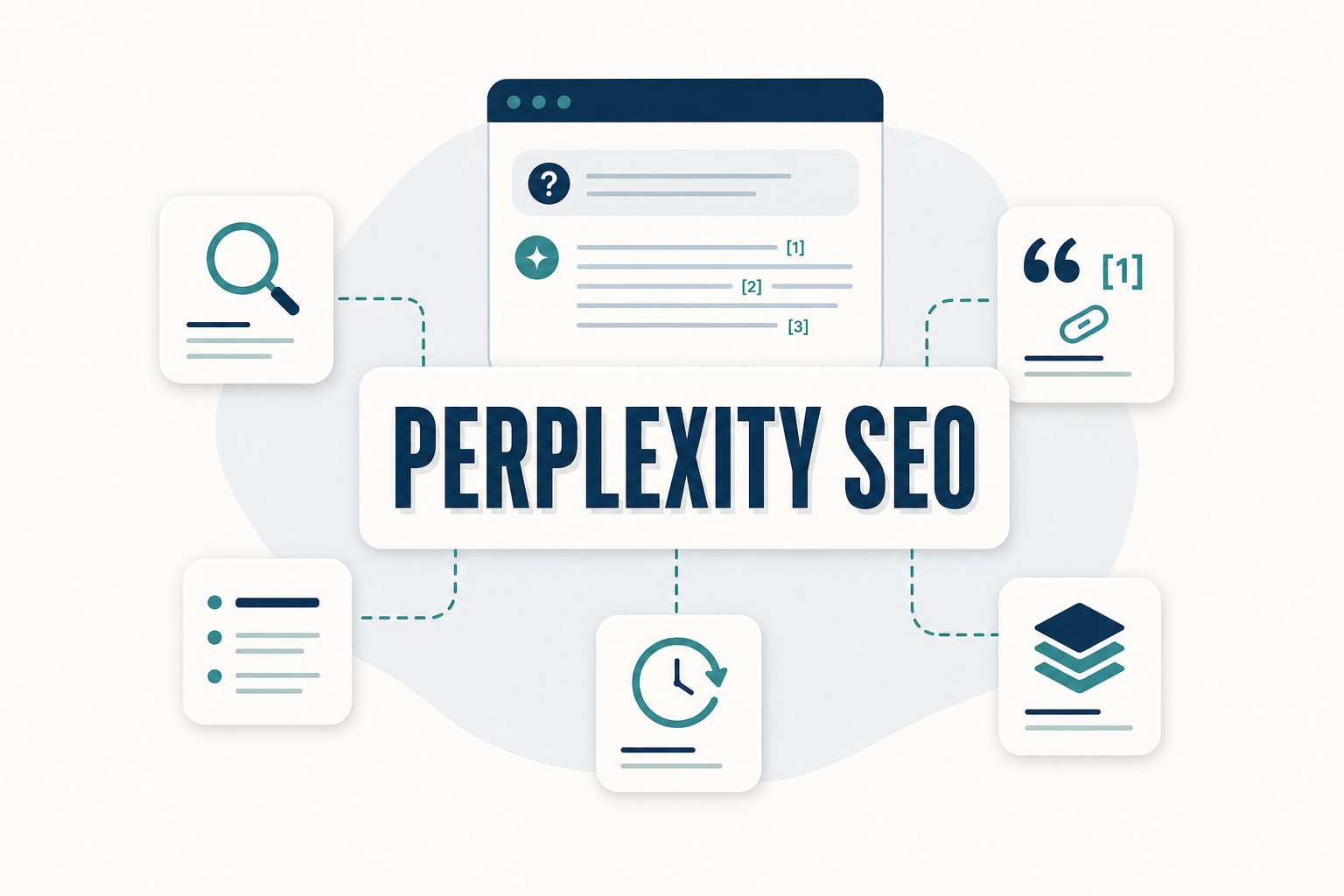
Google hands you a page of blue links and leaves the reading to you. Perplexity reads the web for you and hands back a written answer — with little numbered footnotes beside each claim. Click one and you land on the exact source it pulled from. That's not a chatbot and it's not a search engine in the classic sense. It's an answer engine, and it's rewriting the rules for anyone who writes for the web.
The crucial difference for SEO: Perplexity links out to the sources it cites. Whereas ChatGPT often answers inline with only a few links buried at the bottom, every Perplexity answer is built on numbered citations you can click. Being cited there isn't vanity — it's real referral traffic, sent straight to your pages, and it compounds every time someone asks the same question.
This is a focused, practical guide. No fluff, just how Perplexity decides what to cite and how to make your pages the obvious candidate. If you need the foundations first, our SEO course explains how search engines work from the ground up — and for how the whole search landscape shifted, see how AI changed SEO.
Why Perplexity Is Different From ChatGPT
The single biggest misconception is that all AI answer bots treat your website the same way. They don't.
ChatGPT's default mode answers from memory and only reaches for the web (and links) when search mode is on. Perplexity is built the other way around: as its own help documentation puts it, it searches the internet in real time, pulls from what it calls "top-tier sources," and writes the answer with those sources attached as numbered citations.
That changes what you optimise for — and makes the traffic real:
- Similarweb estimates AI platforms sent over 1.1 billion referral visits to the web's top sites in June 2025 — still tiny compared with Google's ~191 billion, but up 357% year-on-year. ChatGPT drove 80%+ of that, and Perplexity is the one engine that links out on every answer.
- Perplexity isn't niche anymore. Demandsage, citing Wired and Similarweb, puts Perplexity at ~45 million monthly active users, ~170 million monthly visitors, and roughly 780 million queries in May 2025 — and StatCounter credits it with about 6% of the AI-chatbot market.
In short: Perplexity is big enough to matter, and it's the one platform where a citation puts your link directly in front of an engaged reader. Priority one is being quotable and citable — not necessarily ranking #1 in some abstract sense.
How Perplexity Chooses Its Sources
Perplexity doesn't publish a complete ranking formula, but its retrieval pipeline is well understood: it runs a retrieval-and-ranking pass over the live web, then uses a language model to write an answer anchored to the pages it pulled. It favours sources it can ground answers in — pages it can actually extract a defensible, attributable claim from.
In practice the biases are clear:
- Direct, extractable answers beat vague ones. It can't cite a page it can't cleanly pull a claim from.
- Fresh, current sources win for anything time-sensitive. A page updated this quarter beats a five-year-old evergreen.
- Authoritative, well-linked domains carry weight — Wikipedia, reputable publishers and government/industry sources are cited disproportionately, and communities like Reddit rank far higher than in classic Google SEO.
- Provenance and factual precision matter more than with Google. Perplexity rewards pages that say who, what, where, when, with numbers and links of their own.
In other words, it's not just "rank here." It's "be the source Perplexity can quote confidently."
The Tactics: Making Your Site Citable
None of this requires gaming an algorithm. It requires writing the way a good answer engine wants to be quoted.
1. Put a direct answer up top
Perplexity quotes from what it can extract, so front-load a plain-language answer to the question in your first paragraph or section — a concise definition or verdict on top, not buried in prose. Source-selection analyses consistently find this "definition-first" format is what Perplexity rewards.
2. Use clear, structured content and headings
Write for real paragraphs with meaningful H2/H3 headings that read like complete questions or statements. Short, self-contained sections make it easy for a retrieval engine to pull a single attributable block. Break up lists, use bold for key facts, and keep claims near their supporting detail.
3. Establish entity clarity
Make it unambiguous who you are and what you're authoritative about. If you make it obvious you're a web development agency that builds SEO-friendly sites — with consistent name, site-wide descriptors and clear topical focus — the engine can attribute claims to a believable entity, which raises the odds of citation.
4. Be factually specific
Numbers, dates, names, exact configs. A page that says "around 5% of searches" is far less citable than one that says "5.1% in Q2 2026, per vendor X." Specificity gives the answer engine an attributable, defensible claim it can footnote.
5. Stay fresh
Update statistics, review dates and examples. Freshness is a documented bias for time-sensitive queries — stale pages get dropped for newer ones even when the old page is more established.
6. Cite authoritative sources yourself
Perplexity likes sources that are themselves well-grounded. Link out to reputable primary sources; it marks you as a credible aggregator rather than an unverified opinion.
7. Add structured data and a proper sitemap
Schema markup — Article, FAQPage, HowTo, Organization, BreadcrumbList — gives engines machine-readable context about your content's type and structure. Combine it with a cleanly crawlable XML sitemap and fast pages so Perplexity's crawler can actually retrieve what it wants to cite. This is core technical SEO, and the crawler side of AI engines depends on it.
8. Vary your source footprint
Perplexity draws on source diversity — Wikipedia, reputable publishers, official domains — not just your site. So build mentions beyond your own URL: listings, partner sites, industry publications, a Wikipedia-quality profile if you qualify. Being a source across the web makes the engine trust you enough to cite you directly. Multiple engines are converging on this same behaviour, which we'll dig into when generative engine optimization tactics get their own deep-dives.
Being Citable Beats Ranking
The mental shift is the hard part. With Google, the goal is to outrank competitors on a SERP. With Perplexity, the goal is to be the source the answer is grounded in — the domain a retrieval engine can cleanly extract an attributable claim from. Those aren't the same thing. The second is arguably more valuable: a citation sends a click straight to your page from an engaged reader, and it keeps paying off every time that answer gets re-asked.
We build fast, well-structured sites at Digital Yeast, and we handle the on-page, technical and content fundamentals that make a brand citable — not just rankable. Get a quote if you'd like us to make sure your site earns citations from Perplexity and the other AI answer engines.
Want the foundations? Start with What is SEO, see the numbers in How AI changed SEO, or browse all our posts.
Sources
- Perplexity Help Center — How does Perplexity work?
- Similarweb — AI Referral Traffic Winners By Industry
- TechCrunch — AI referrals to top websites were up 357% year-over-year in June, reaching 1.13B
- Demandsage — Perplexity AI Statistics (citing Wired & Similarweb)
- StatCounter — AI Chatbot Market Share

Comments (0)
No comments yet. Be the first to share your thoughts!
Leave a Comment
Your email address will not be published. Required fields are marked *